How creation
bows.
The sun, the mountain, the tree, the shadow: none chooses, yet all submit. What can physics show us—and where must it remain silent?
Watch the shadow move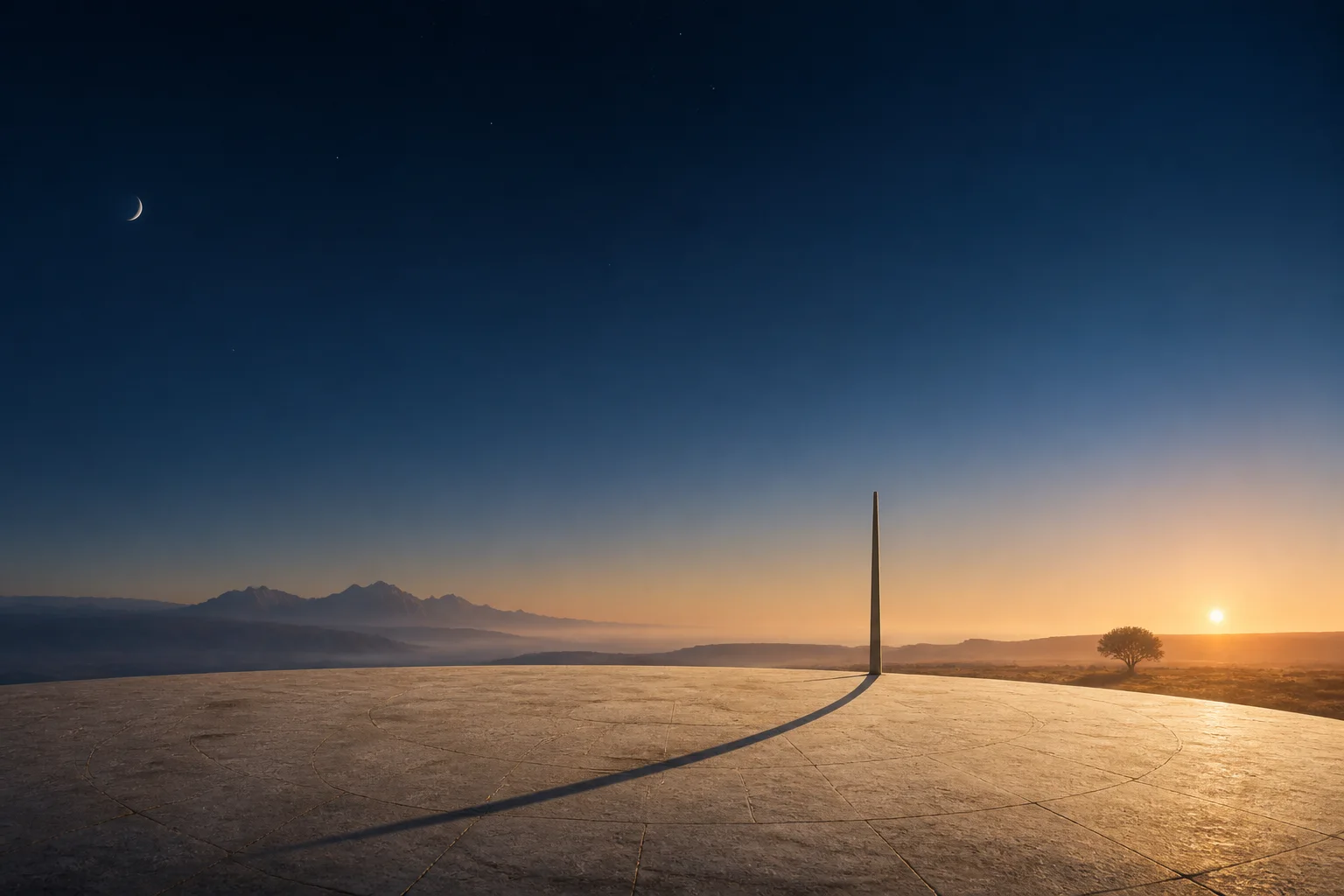
“Do you not see that to God prostrates whoever is in the heavens and whoever is on the earth, and the sun, the moon, the stars, the mountains, the trees, the moving creatures—and many of the people?”
AL-ḤAJJ · 22:18
I know my own sujūd: forehead to the ground, and a will that knows what it is doing. But what is the sun’s? What is a mountain’s, a tree’s, a stone’s? These things do not pray as we pray or choose as we choose. Is sujūd here only a figure of speech—or a truth that leaves an imprint we can see and measure without pretending we have enclosed its mystery?
The verse speaks of complete submission, not the prostration of limbs. Physics can make that submission visible through universal laws, stable constants, orbits, growth and shadow. It cannot uncover the unseen manner of that sujūd, but it can place before us a cosmos that never negotiates with its laws or steps outside them.
Science is a witness here. It is not the interpreter.
The sun moves through the sky. The shadow tells the story on the ground.
Begin without the numbers. Imagine a vertical rod in an open courtyard. When the sun is high, its shadow is short. As the sun descends, the shadow reaches outward. Between those positions, the earth records passing time in light and darkness.
-
1
Find the sun
Its altitude determines the shadow’s length. The higher the sun, the shorter the shadow; the lower the sun, the farther it reaches.
-
2
Follow the blue line
This is the shadow at the selected moment. It always points away from the sun and turns as the earth rotates.
-
3
Read time from length
When the shadow reaches a defined length after noon, ʿaṣr begins. Observation and worship once met in the same instrument.
The shadow square on an astrolabe divided its gnomon into twelve digits. If this display reads 24, the shadow is simply twice the rod’s height.
The first adds one object-height to the noon shadow, used by the majority. The second adds two, used by the Ḥanafīs. Move the slider to watch each threshold arrive.
Build an observatory with a pencil and three marks.
You do not need an astrolabe or an equation. On a sunny day, stand a pencil or small stick vertically in a piece of clay and place it on paper that will not move. Mark the tip of its shadow three times: in the morning, near noon, and two hours later.
Join the marks and a small arc appears. The shortest shadow gathers around solar noon; its direction turns gradually because the earth itself is rotating beneath the light. You are not merely watching a shadow move. You are seeing the motion of an entire planet written across one sheet of paper.
- Morning
A long shadow reaches away from the sun.
- Solar noon
The day’s shortest shadow becomes the reference for ʿaṣr.
- Afternoon
The shadow lengthens on the other side until the horizon takes the light.
This observation does not say that sujūd is the shadow. It leaves you with something more careful and harder to forget: a silent thing, without a will of its own, writing its submission across the ground moment by moment.
Clearing the ground: what is sujūd?
Most of the confusion in this subject comes from running two different questions together. What does sujūd mean? — a question of language and revelation. And how does it occur? — a question of modality, and modality belongs to the unseen. Empirical science answers neither one directly. What it does supply is a third thing, and a useful one: evidence of submission. Which is precisely what the verse asks for when it opens with “Do you not see”.
The root meaning of sujūd is lowering, yielding, bending down; revelation then reserved the word for placing the forehead on the ground in worship. What's meant here is that all things fall under God's grip and His subjection, that they obey His will completely, and that they do so in a manner He knows. We affirm the sujūd and leave the manner to Him.
Scholars divided sujūd in two, and the verse gathers both halves into a single sentence. That's the key to it:
What is meant by the sun, the moon, the stars, the mountains, the trees, the creatures. No choice in it, no possibility of refusal.
What is meant by “and many of the people”. It happens by will, and it can be withheld — and whoever withholds it, “upon him the punishment has been justified”.
Notice how precisely the sentence is built. The whole cosmos is named without division; only the human beings split into two. The sun has no option. The human being does. That is the verse's first purpose.
Mujāhid said their sujūd is the turning of their shadows. It's a strong reading, and “their shadows incline to the right and the left, prostrating to God, humbled” [al-Naḥl 16:48] supports it. It is also the only face of this that you can watch happen — which is why it opens this page.
The physics: what corresponds to total submission?
Translate “total submission, without exception” into the language of physics and you get something close to this: the universality of the laws and the constancy of the fundamental constants across space and time. That isn't a philosophical platitude you assert and move past. It's a measurable claim, and it has been measured — to a startling precision.
Bounds on variation in the fine-structure constant α
The measurements below are not one quantity, and nothing is gained by stacking them in a single column. |Δα/α| is a dimensionless difference between two epochs. |α̇/α| is a rate, carried in yr−1. Each gets its own axis, with its own unit and its own range, and the two do not map onto one another. A longer bar means a tighter bound.
-
As published: Δα/α = (−1.1 ± 0.4) × 10−5, from 30 absorption systems at 0.5 < z < 1.6.
-
As published: −0.9 × 10⁻⁷ < Δα/α < 1.2 × 10⁻⁷.
-
As published: −4 × 10⁻¹⁷ < α̇/α < 3 × 10⁻¹⁷ yr−1. It assumes a constant drift across 1.8 Gyr, so it isn't a present-day measurement the way the clock bound is — this axis shares a unit with it, not a method.
-
As published: α̇/α = 1.0(1.1) × 10−18 yr−1 — consistent with zero; the bracketed figure is the uncertainty.
Add two cosmological witnesses: big bang nucleosynthesis at t ≈ 3 minutes, and the cosmic microwave background spectrum at z ≈ 1100. Both require the nuclear and electromagnetic forces to have carried the same calibration we measure in the lab today. A hydrogen atom in a galaxy twelve billion light-years away obeys the identical rule as the one on your bench.
This, to my mind, is the closest scientific analogue to what sujūd of subjection means: no exception, no negotiation, no anomaly. The particulars only sharpen it.
The sun
Hydrostatic equilibrium: a permanent gravitational collapse held off, instant by instant, by radiation and gas pressure. And it self-regulates — a slight rise in fusion rate expands the core, which cools it, which drops the rate back. An enormous body that cannot step outside its balance for a moment.
The moon
Tidally locked in synchronous rotation — one face bowed toward the earth, permanently, as the inevitable outcome of tidal dissipation over hundreds of millions of years. Here the image of submission is close to literal.
The stars
The sun itself orbits the galactic centre on a circuit of roughly a quarter of a billion years, each body seated in a nested hierarchy of orbits. “Each in an orbit, swimming.” “The sun and the moon, by exact calculation.”
The mountains
Isostatic balance — a mass floating on a ductile mantle, with a root proportional to its height, and uplift and erosion rates governed by equations it does not violate.
The trees
Gravitropism: cells in the root cap sense the gravity vector through sedimenting starch grains, auxin is redistributed, and the root bends downward. Phototropism runs through the phototropin receptors. A plant with no nervous system measures the direction of the gravitational field and answers it. If there is such a thing as structural submission you can measure, this is it.
The shadows
The finest of them. The shadow leans, lengthens, shortens, then lies flat along the ground at sunset — a purely geometric consequence of the earth's rotation and the tilt of its axis. A sujūd you can watch, precise enough to compute the hour and the qibla from.
Where we should stop
This matters more than everything above it. I'll say my position plainly: here science works as a witness and fails as an interpretation. The difference is not cosmetic.
Using hydrostatic equilibrium, tidal locking, and the constancy of the constants to bring the meaning of submission closer, and to move the reader to reflect. This is exactly the contemplation the Qur'an commands.
Saying that sujūd is gravity, or that the verse announced hydrostatic equilibrium. That's a reduction, and it damages the meaning from both ends: it shrinks sujūd below its unseen reality, and it makes the truth of the verse hostage to a physical model that is open to revision. Think how many “settled” astronomical models were revised inside a single century.
It became popular to tie the ḥadīth of the sun's prostration to the solar system's motion toward the apex in Hercules, and to treat that point as “the place of the prostration”. The inference is weak. The ḥadīth names no astronomical direction at all, and the solar apex is a frame-relative quantity, measured against the local standard of rest rather than any absolute centre. Explaining the unseen by a frame-dependent datum is a methodological error, and it does religion no favours.
The ḥadīth of the sun's prostration
Reported by al-Bukhārī in the Book of the Beginning of Creation (3199) and by Muslim in the Book of Faith (159), from Abū Dharr: that it goes until it prostrates beneath the Throne, then asks permission and is granted it. The wording indicates a perception and discernment that God creates in it, suited to what it is.
The sound way to handle it is Ibn Kathīr's: the ḥadīth does not mean the sun ascends above the heavens. It sets from our eyes while continuing in the orbit it is in. Sunset is a description from the observer's position — and it is physically correct in the earthbound observer's frame, exactly as a working astronomer today says “sunrise” and “sunset” without thereby denying that the earth rotates. The prostration itself is a time and a place belonging to the unseen, and no telescope has any route to it.
The position, in short
The verse states an ontological fact: every existing thing submits completely to its Creator, in a manner partly visible and partly unseen. Modern physics — through the constancy of its constants and the universality of its laws — offers the deepest empirical testimony anyone has ever assembled for that submission. But it testifies. It does not interpret.
And here is the paradox the verse carries: the only thing in existence that can breach this submission is not a star and not a mountain. It's the human being.
An atom beneath the ground is more obedient than a man standing on it.
Sources
The bounds on α
- Quasar spectra — J. K. Webb, V. V. Flambaum, C. W. Churchill, M. J. Drinkwater & J. D. Barrow, “Search for Time Variation of the Fine Structure Constant”, Phys. Rev. Lett. 82, 884 (1999). doi:10.1103/PhysRevLett.82.884
- The Oklo bound, reference statement — T. Damour & F. Dyson, “The Oklo bound on the time variation of the fine-structure constant revisited”, Nucl. Phys. B 480, 37–54 (1996). doi:10.1016/S0550-3213(96)00467-1
- Oklo reanalysis — Yu. V. Petrov, A. I. Nazarov, M. S. Onegin, V. Yu. Petrov & E. G. Sakhnovsky, “Natural nuclear reactor at Oklo and variation of fundamental constants: Computation of neutronics of a fresh core”, Phys. Rev. C 74, 064610 (2006). doi:10.1103/PhysRevC.74.064610
- Atomic clock comparison — R. Lange, N. Huntemann, J. M. Rahm, C. Sanner, H. Shao, B. Lipphardt, Chr. Tamm, S. Weyers & E. Peik, “Improved Limits for Violations of Local Position Invariance from Atomic Clock Comparisons”, Phys. Rev. Lett. 126, 011102 (2021). doi:10.1103/PhysRevLett.126.011102
Tafsīr and ḥadīth
- Tafsīr of the verse (Ibn Kathīr, al-Qurṭubī, al-Wasīṭ) and the two kinds of sujūd: surahquran.com/aya-tafsir-18-22 · surahquran.com/aya-18-sora-22
- IslamWeb fatwa on the verse covering both subjection and choice: islamweb.net/ar/fatwa/64815
- The ḥadīth of Abū Dharr with commentary — Ḥadīth Encyclopedia: hadeethenc.com/ar/browse/hadith/65070
- Ibn Kathīr and Ibn Ḥajar on the ḥadīth and the astronomical objection: islamweb.net/ar/fatwa/99520
- Lesson by Shaykh ʿAbd al-Raḥmān al-Shahrī on the verse: ar.islamway.net/lesson/189852